What Is A Rising Wedge And How Does It Appear?


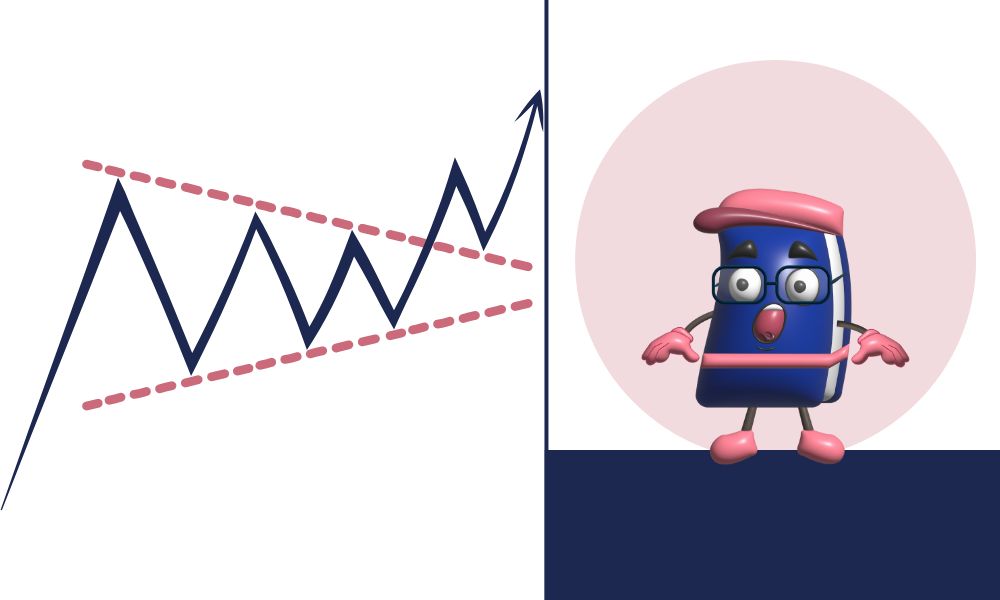
A rising wedge is a bearish chart pattern that consists of two trend lines that meet in the center. The trend lines rise up to meet each other.

The first trend line connects the recent lower highs and higher highs, and the second trend line connects the recent lows. The shape that is made looks like an up-angled triangle. The pattern of a rising wedge is a falling wedge.

The rising wedge pattern could be seen as a bearish wedge, since the low is higher than the high and the lower trend line is steeper than the upper one.

Even though the falling wedges have a similar shape, the only things that make them different are the angle of the triangle and what the pattern suggests.
 

The rising wedge (ascending) pattern, in which trade volume declines as the wedge develops, forecasts future dropping prices or a breakout to a downtrend, making it a bearish pattern.

Despite the wedge capturing the price movement continuing higher, the declines in trade volume could indicate that sellers are consolidating their position in preparation for a bearish breakout.


🔷Keep Pushing Your Profitable Trading With🔷

🔷AssetsFX🔷


The falling wedge (descending) pattern, on the other hand, has a negative slope, slanting downward and predicting a nearby rebound, making it a bullish pattern.

The fascinating thing is that a rising wedge can appear during a downturn as a continuation pattern or during an uptrend as a reversal pattern.

How Do Rising Wedges Appear?

When two trend lines intersect, the rising wedge pattern becomes the shape of a slice of pizza. The rising wedge pattern creates a series of higher highs and lower lows.

The resistance trend line must cover the pattern's extreme high points. The resistance line requires a minimum of two higher highs.
 

Similarly, construct a support trend line that encompasses the higher lows. To create the support trend line, you'll need at least two swing lows.

After drawing the resistance and support trend lines, you should observe a triangular form that resembles a wedge. The apex of the triangle in the rising wedge pattern must be directed upward.
 

As a result, the resistance trend line must slope upward to qualify this as a rising wedge pattern.

Even though it might be challenging to see in real time, the rising wedge pattern is a favorite among traders and technical experts.


angelTop THREE Award-Winning Brokers in 2022angel
LiteFinance
IC Markets
Avatrade


It is common practice to confuse the rising wedge pattern, which is a reversal formation, with the triangle pattern, which is a continuation formation.

The obvious entry and exit indications that are provided by the ascending wedge pattern make the rising wedge a perfect choice for traders who wish to short the market or use the signals to manage their long-term HODL positions.

AssetsFX

Comments

Popular posts from this blog

Inflation is anticipated to have an impact on fuel demand, which is contributing to a decline in the price of oil.

On Tuesday, oil prices declined, erasing some of the gains made in the previous trading session. This was due to market participants' concerns that more aggressive interest rate hikes from central banks could result in a worldwide economic slowdown and a reduction in the demand for fuel. After gaining 4.1% on Monday, the largest gain in more than a month, Brent crude futures LCOc1 for October settlement dropped 81 cents, or 0.7%, to $104.28 a barrel as of 03:59 GMT on Tuesday. This coming Wednesday marks the end of the October contract, while the more active November contract was trading at $102.33, a decrease of 0.6%. Following a surge of 4.2% in the previous session, the price of U.S. West Texas Intermediate crude CLc1 was reported to be $96.68 per barrel, a decrease of 33 cents, or 0.3%. Inflation is close to reaching double digits in many of the world's largest economies, a level that has not been seen in almost half a century. This could prompt central banks in the United ...

Following The Historic Fed Rate Rise, Hong Kong Stocks Fell To An 11-Year Low

Hong Kong stocks sank to their lowest level in more than a decade on Thursday, as did other Asian markets, after the US Federal Reserve hiked interest rates by  75  basis points and anticipated further rises, fanning fears of a recession. The Hang Seng Index (HSI) plummeted  2.6% , breaking below  18,000  points before rebounding somewhat. It closed  1.6%  down at  18,148 , its lo west level since December  2011 .   The S&P/ASX 200 index in Australia sank  1.6% , while Japan's Nikkei 225 (N225) and South Korea's Kospi also declined 0.6%. The Shanghai Composite Index (SHCOMP) in China fell  0.3% . European stocks dipped in early trade as well. The FTSE 100 (UKX) index in London fell approximately  0.3% , while the DAX (DAX) in Germany and the CAC40 (CAC40) in France both down about  0.7% . Stock futures in the United States were slightly moved. The drops occurred after the Federal Reserve authorized a third straig...

Weekly Outlook: GBP/USD

In the last five days of trading, the GBP/USD had another week of chaotic results, and it's likely that the currency pair hasn't seen the end of chaotic results yet. The GBP/USD hit a high of almost 1.14950 on October 4 and 5. Some traders might think this has a lot to do with the "turnaround" of the Conservative government under Liz Truss, but they might be wrong. When the proposed tax plan of the U.K. government got a lot of bad press, the government pretty much gave up on it. Prime Minister Liz Truss changed her mind about what she said she believed in just a few days. Many financial institutions were not happy about this. The GBP/USD exchange rate will be around 1.10900 when the week starts. Before last week's weekend, the GBP/USD was almost always trading calmly near the 1.12100 ratio. The markets turned again when the U.S. jobs report came out and was better than expected. The situation is a mess because of bad leadership and unclear interest rates. Early la...